
Cold protection gloves
For outdoor work, cold stores and anywhere hands cool down over hours. Lining alone is not enough if moisture gets in from outside.
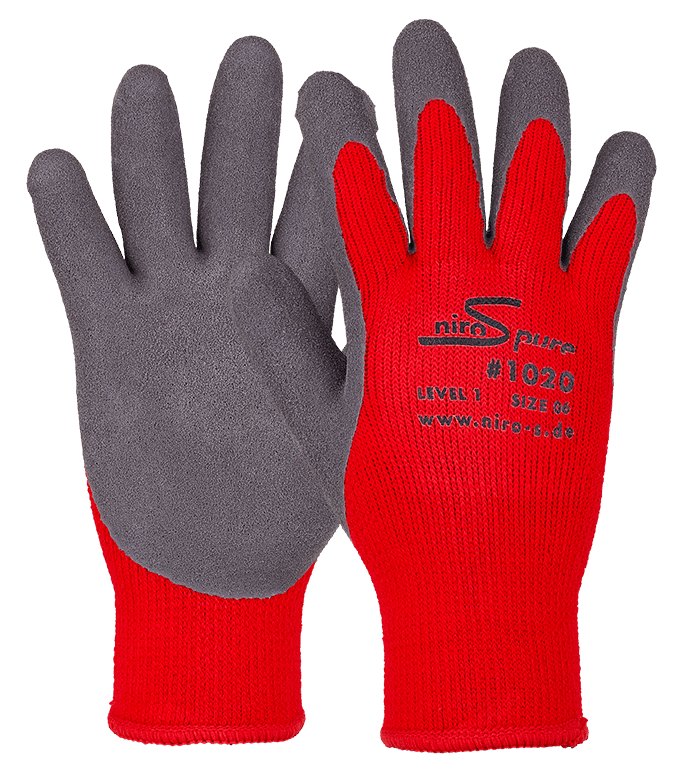
NIRO-S ice #1020
Terry - 10 Gauge brushed inside
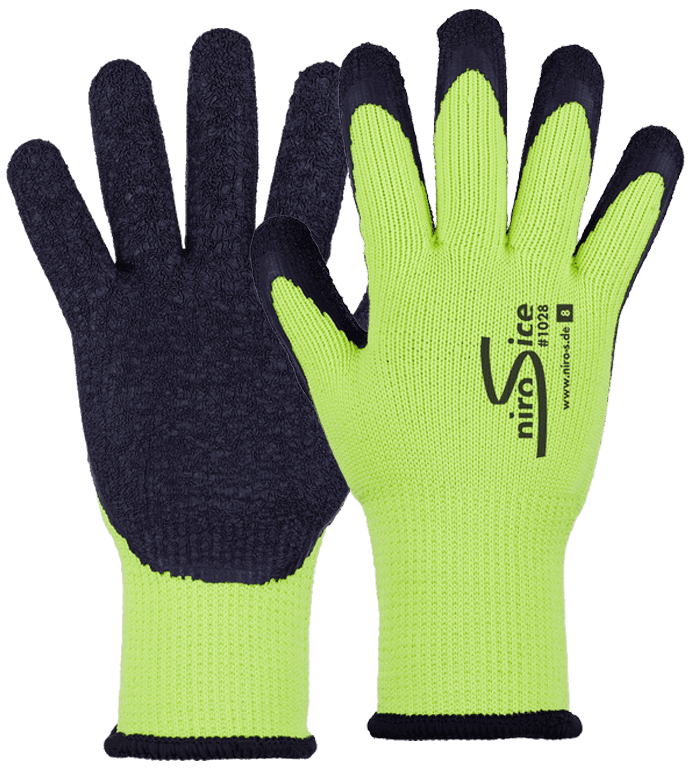
NIRO-S ice #1028
Polyester Terry - 7 Gauge Brushed
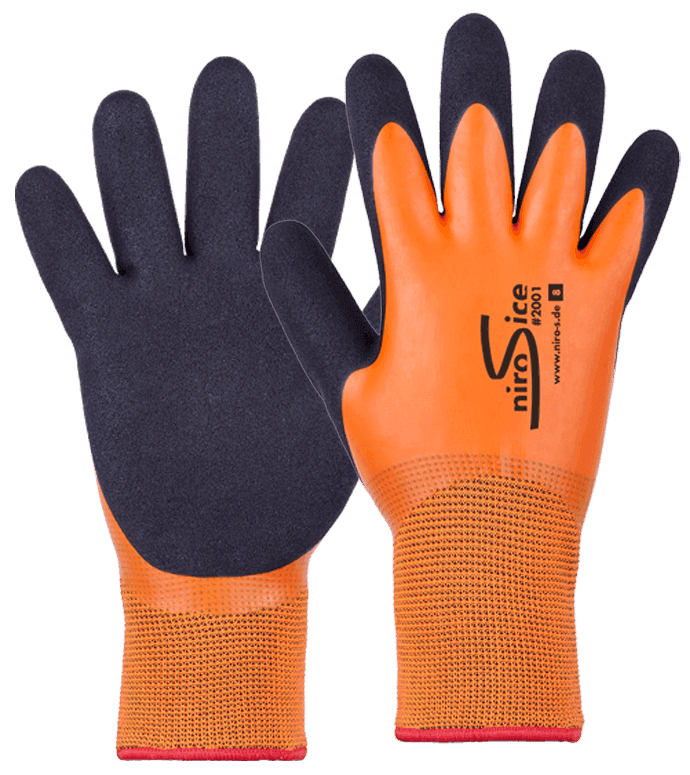
NIRO-S ice #2001
13G polyester exterior and 10 gauge acrylic terry cloth interior
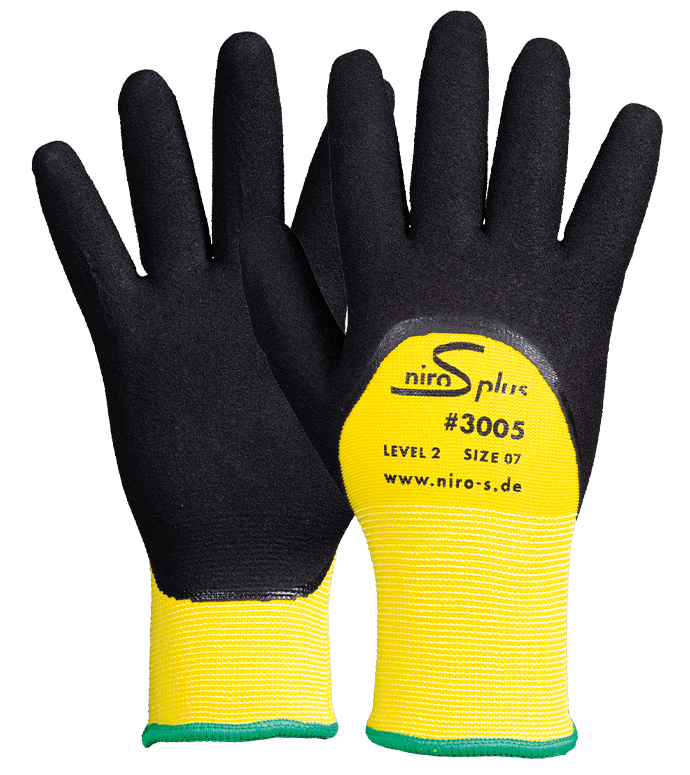
NIRO-S ice #3005
Terry - 10 Gauge brushed
What matters here
Cold is covered by EN 511, not EN 388. The standard tests three things separately: protection against convective cold, meaning ambient temperature, protection against contact cold when handling cold parts, and water penetration. Each digit stands for one of these, and a glove can be strong in one and weak in another.
Wet lining stops insulating. The outer coating therefore decides how warm the glove stays: it keeps moisture out so the lining can do its job. Where wet parts are handled, that matters more than the thickness of the lining.
Sizes are chosen more generously on lined models than on summer gloves. A glove that is too tight presses, restricts circulation and cools the hand faster than no lining at all. The still air inside the glove is part of the insulation.
Cold protection gloves are thicker and cost tactile feel. For work that demands dexterity a two-glove system is often more practical: the lined glove for time outside, a thin assembly glove for fine work.
More on this: what the EN 388 digits mean and which glove suits which job.
Frequently asked
What do the EN 511 digits mean?
The first stands for convective cold, the second for contact cold, the third for water penetration. The first two run from 0 to 4, the third is 0 or 1. A 1 in third position means no water came through during the 30 minute test.
Is a winter glove enough for a cold store?
In a cold store contact cold matters most, because cold goods and racking are handled constantly. The second digit of the EN 511 marking is more important there than a good convective cold value.
Does a cold protection glove also need an EN 388 marking?
The two standards do not exclude each other, quite the opposite: almost every model carries both, because things still get gripped, pulled and pushed in the cold. EN 511 describes the thermal side, EN 388 the mechanical one. Anyone moving sheet metal in winter should look at both markings and not only at the lining.