
ESD gloves
In electronics manufacturing the glove does not protect the hand, it protects the component. Damage from a discharge often shows up only weeks later.
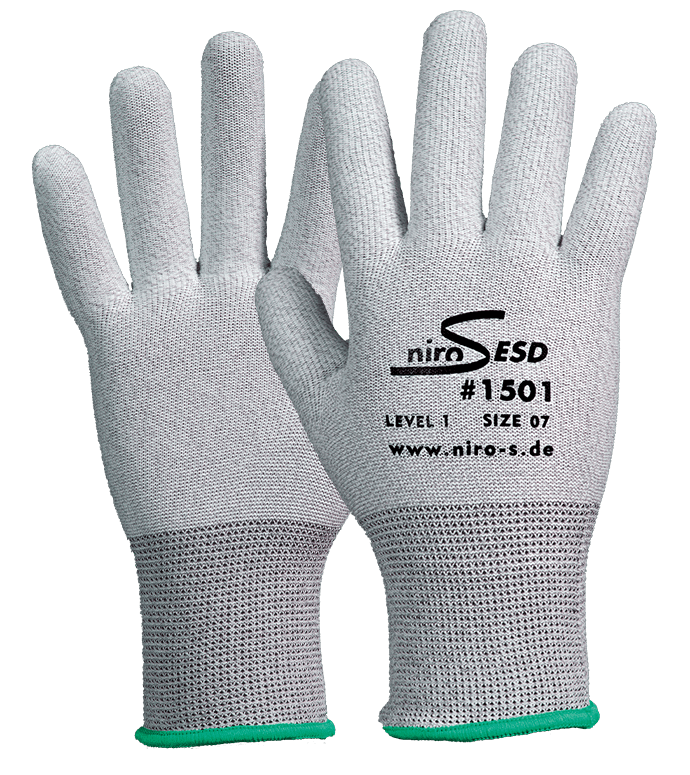
NIRO-S esd #1501
Polyester / Carbon - 15 Gauge
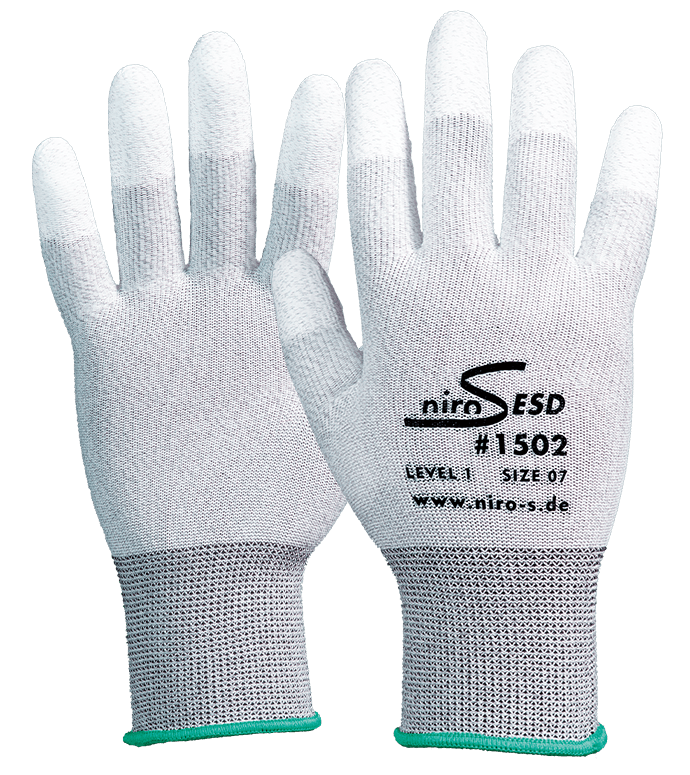
NIRO-S esd #1502
Polyester / Carbon - 15 Gauge
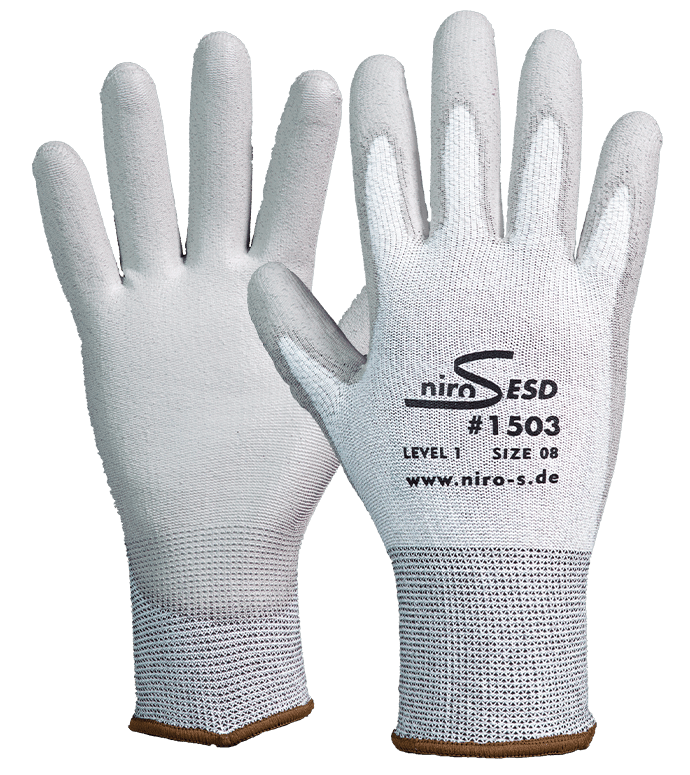
NIRO-S esd #1503
Polyester / Carbon - 15 Gauge
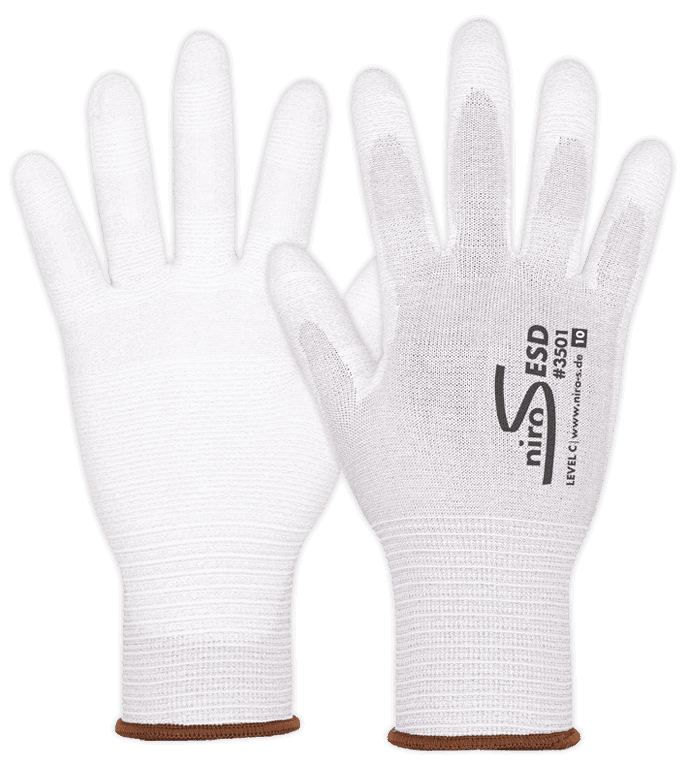
NIRO-S esd #3501
HPPE / Carbon - 13 Gauge
What matters here
ESD capability is not protection for the wearer. A dissipative glove keeps electrostatic charge from building up on the hand and discharging into a board on contact. People notice a few thousand volts; sensitive components take damage at a few hundred.
An ESD glove only works as part of a concept. Dissipative flooring, a grounded bench mat and a wrist strap belong to it; the glove alone replaces none of them. Conversely an ordinary glove can defeat the other measures by insulating the hand from the grounded path.
The dissipative property usually comes from carbon or copper threads knitted into the fabric. They may allow touchscreen use, which is handy at test terminals on the line, but that is a side effect and not a guaranteed property.
Where mechanical risk exists alongside electrostatics, one model has to cover both. The EN 388 marking says nothing about dissipative behaviour, and the reverse holds too.
The charge does not arise in the glove but from friction and the separation of materials: getting up from a chair, unrolling adhesive tape, walking across an insulating floor. Dry heated air in winter makes this considerably worse, because without humidity the charge no longer drains away. That is precisely the season when unexplained failures pile up in rework.
More on this: what the EN 388 digits mean and which glove suits which job.
Frequently asked
Does an ESD glove replace the wrist strap?
No. The wrist strap provides the defined connection to ground, the glove only keeps charge from collecting on the surface of the hand. Each does a different job.
Do ESD gloves lose their effect over time?
The dissipative property sits in the knit and is retained in principle. Contamination with insulating residue such as flux or grease can impair it, so visibly soiled gloves should be replaced in ESD areas.
Why is an ordinary glove not enough?
Because it insulates. A normal knitted glove separates the hand from the grounded path and can even promote charge as it rubs against the skin when put on and taken off. In an ESD area the wrong glove is therefore worse than none at all, because it defeats the other measures without anyone noticing.